Tag: Powerlifting

What is RAW Powerlifting?

The Definition Of RAW Lifting

The definition of RAW Powerlifting. Plus, the minimum and maximum amount of lifting equipment and gear you are allowed to use in competition.

raw powerlifting squat

The following is the definition of what we powerlifters consider a lift to be done “RAW”.

“RAW” determines the assistance you are allowed to use for training and testing your lifts. What we consider to be RAW is the same as what most sanctioned Powerlifting Competitions also consider to be RAW.

This is different than what is considered to be 100% RAW. 100% RAW means without any assistive equipment at all, as if you were only lifting in shorts and a t-shirt.

RAW lifting allows for some safety equipment to accommodate more people and promote the safety of the lifter, above all else.

To be considered RAW when lifting you can use the assistance of:

  • a weight lifting belt,
  • non-supportive knee or elbow sleeves,
  • chalk as needed,
  • and wrist wraps if needed.

*Non-supportive knee and elbow sleeves are used to promote joint safety by keeping them warm but add little to no actual lifting support.

This amount of equipment promotes the safety of the lifter while allowing for only necessary assistance.

Overall, the lifter has to do the lift, not the equipment.

The more equipment you use, the more you have to rely on when it counts. It is best to only use what you need to be safe and save the rest for when you absolutely need it.

RAW Powerlifting Programs >>


Drugs and Supplements

Being RAW also does not allow the use of drugs or special supplement regiments that greatly improve a lifter’s strength, recovery or muscle growth.

Basically, if you would fail a drug test using it, then it is not RAW.

To be clear, no supplements are needed to make your program work as effectively as possible. It is all about how much you put in.

Lifting Equipment

Lifting equipment is anything that directly improves your ability to lift more weight. This could be very light assistive gear, such as knee or elbow sleeves, all the way up to extremely supportive gear, such as lifting suits.

One of the most common pieces of equipment to be used is a lifting belt. When used properly, a lifting belt allows you to better brace your core for stabilization by increasing the intra-abdominal pressure placed on your spine. By increasing stabilization you are enabled to lift heavier loads.

Equipment can improve lifter strength and safety, but can also have adverse effects when used improperly.

If any one piece of equipment is used too frequently, then it will limit your body’s ability to grow stronger in that area. Essentially, the equipment will become a crutch that then must be used every time training occurs in order to keep up with the strength developed in other non-supported areas.

The most effective way to use equipment is only when it is necessary.

For example, when using light to moderate loads (<75%) avoid using any equipment at all to build greater strength in all areas. Then when you put on equipment for maximal loads (>80%) you will be that much stronger.

Even if you have an injury, only use the equipment when you need it. If your injury does not hurt, then do not cover it up with equipment. Allow it to grow stronger.

When you are building strength, use little to no equipment.

When you are testing strength, use whatever you can to improve your lift.


Strength Programs >>

Get the latest Powerlifting News >>

Ironworks Gym

Ironworks Gym is located in historic downtown Grass Valley, CA and is open 24-hours to the local community and members. Stop by today or make an appointment to start getting the best workouts of your life, at a reasonable price! 

Ironworks Gym in Grass Valley CA

  • Get all of the best supplements right at the front desk! HUGE selection!
  • The best fitness, bodybuilding, and powerlifting equipment in town!
  • We support the Silver Sneakers program for seniors!
  • Extremely knowledgeable trainers!
  • Some really nice people!

Home of the Mathias Method Strength Warriors!

Also, we have some really great Workout Programs and Apparel that our members love!

About IronworksIronworks gym in grass valley ca

Ironworks is one of the premier gyms in grass valley, CA and offers a judgment-free zone where anyone can train hard to get in shape.

We’re a place for true fitness enthusiasts, bodybuilders and powerlifters to focus on their workouts and improving their strength.

As a 24-hour gym, you’ll always be able to find a time to stop in to work toward your goals.

Plus, our top-of-the-line equipment ensures that you’re getting the most out of the time that you spend here!

Our owner, Curtis P., has an extensive background in Personal Training, and he’s committed to using that knowledge and passion to create a positive push on strength training.

This facility is great for anything from Silver Sneakers and general fitness to our own Grass Valley Powerlifting Team, the Mathias Method Strength Warriors! Check for local powerlifting meets here!

Make sure you read these Top 20 Gym Etiquette Rules Everyone Needs To Know before you stop by!

Stop by today or make an appointment to start getting bigger, stronger and leaner than ever before!

Contact Information

Address:

Ironworks Gym

153 South Auburn St.

Grass Valley, CA 95945

United States

Phone #: (530) 272-9462

Hours: 24 Hour Gym

Office Hours: 10:00am-3:00pm Mon-Fri, Sat by Appointment

Get stronger, build muscle, and lose weight the right way at Ironworks Gym today!

Find Ironworks Gym

Website: IronworksGym247.com

Facebook: Facebook.com/Ironworks247/

Instagram:@IronworksGymCA

Stronger Mass | Powerlifting Program for Strength and Size

Build Muscle Mass and Strength with Volume Training

This is a 12-week powerlifting program for building muscle size and strength. The focus will be on heavy volume training to get stronger and build muscle, fast! This means, a lot of sets, a lot of reps, and a lot of work. But, if you can get through it, this program will make you brutally strong. I guarantee it!

Get the updated version of this program >>

Or maximize your results with a Custom Powerlifting Program made just for you!

Mathias Method Powerlifting 430 Squat The Thunder God (Thor), aka Reid England, putting the hammer down on a 430 pound squat! A 2X Bodyweight Squat!

Just remember, for us mere mortals it’s crucial to have a great squat rack and/or spotter when using this program. You can get all the powerlifting equipment you need at Relife Sports.

This Powerlifting Program is based on the Mathias Method Strength System. 


About the Stronger Mass Powerlifting Program

Powerlifting is a competitive sport that takes years of hard work and consistent dedication to become proficient at.

Lifters must constantly be working on their lifting technique and maintain that technique the best they can through the high-intensity workouts they endure. These workouts can often last hours depending on your strength level.

As you get stronger it takes more time to warm-up to your working weights and you have to constantly be adding more work through increasing the weight, sets and/or reps performed. Your gym workouts will often be 6-10 sets of few reps with the same weight to accumulate volume and strength over time. Numerous sets with few reps are the best way to gain maximal strength because you are practicing your setup and technique with intense weights, numerous times during a workout.

It’s All Focused on Meet Day!

Your set-up, how you perform each lift, along with everything else in this 12-week hybrid powerlifting program for mass, is focused upon obtaining the most strength for week 12. Week 12 is your competition week and there should be no lifting done during the last 2-3 days leading up to your competition day. Do your training early in the week with little accessory work so that you are fully recovered before the meet.

This 12-week powerlifting program will guide you through the exact work you need to do leading up to your next competition.

Powerlifting for Mass Program Details

This is a 4-day per week powerlifting program. You will have both heavy and light training days for each of your weekly main lifts.

For heavy training days, you will switch between a squat versus deadlift focus. One week you will do most of your work with the squat and then use a deadlift variation (block pulls, deficit, bands, chains, etc.) as an accessory lift. The next week you will do the opposite with deadlift being the focus and have a squat variation (box squats, pause squats, bands, chains, etc.) as your accessory lift.

This will allow you to focus on one lift at a time while allowing the other to recover before the next heavy session.

Heavy bench days will go heavy every week that is not a deload. The deload weeks should be used for bench press variations (close grip, floor press, bands, chains, etc.) utilizing repetition work to build up all parts of the lift.

Be sure to practice your lifts exactly how they are supposed to be performed in the competition. That means practicing holding deadlifts at the top and pausing bench presses as you get closer to the competition.

Intensity Sets

Also, on heavy training days, you will utilize an overload set to better prepare yourself for the competition. This is one set that is either an AMRAP (as many reps as possible) done with the same working weight or a daily max.

For the daily max, work up to a weight that is difficult to do for that day, but you are still able to maintain reasonable technique. Your intensity set should never be done to failure because this teaches improper technique which will decrease your maximal strength potential.

Heavy vs Volume Training

Heavy training days work on building brute strength to increase your max as lighter training days are used each week to increase training volume while decreasing the overall stress placed upon your body.

By going heavy too often our bodies may not be able to recover and therefore are at a higher risk of injury. By training with sub-maximal weights, we can utilize dynamic speed training, with the use of bands or chains, to increase our training volume and power; or utilize volume training/ repetition work to build more size.

Both are effective ways of decreasing the overall stress placed upon your body while adding to your strength potential. By utilizing lighter and heavier training days each week they will build upon each other to further increase your maximal strength.

Recovery Week

Every 4th week is a deload and recovery week. This is a week where you will still get a good amount of training volume in but it will allow your body to recover from the high-intensity work, and decrease your risk of injury.

There will be no deadlifts done on this week, but you should utilize an exercise variation that will help build up your lower back such as good mornings or reverse hyperextensions. For your heavy squat and bench press exercises, utilize a variation that builds up your weaknesses in those lifts.

Stay focused, train hard and get stronger!

Optimal Weekly Training Schedule

  • Day 1 – Workout-1: Heavy Squat / Deadlift Training
  • Day 2 – Rest
  • Day 3 – Workout-2: Heavy Bench Press Training
  • Day 4 – Rest
  • Day 5 – Workout-3: Volume Squat Training
  • Day 6 – Workout-4: Bench Press Volume Training
  • Day 7 – Rest

Stronger Mass Powerlifting Program Lifting Chart

Download The Interactive Worksheet: Powerlifting Size Excel Worksheet created by Josh Drake, of the Strength Warriors!

  • Just plug in your Squat, Bench Press and Deadlift Maxes for each week and it will automatically calculate your weekly working weight for you!

Heavy Training Days  /  Volume Training Days

Stronger Mass Powerlifting Program Training Chart

1Use your competition opener for all 10 sets. Usually, something you can do 3 reps with.

PRINT this Powerlifting Program


Are you looking to build up one specific lift? Check out our Squat, Bench Press and Deadlift specific Powerlifting Programs:

  1. Squat Powerlifting Program

  2. Bench Press Powerlifting Program

  3. Deadlift Powerlifting Program

Get all 3 Powerlifting Programs!

Or get our FULL POWER Powerlifting Program

More Powerlifting Programs >>


Workout 1: Heavy Squat / Deadlift Training

500 lb powerlifting squat

Warm-Up & Technique Work:

Weighted Pull-Ups – x 25 total

Box Jumps 3-5 x 3

Pause Squat or Deficit Deadlift (<50%) 3 x 5

–

Main Lifts:

Squat or Deadlift See Table

*Overload Set 1 x AMRAP or Daily Max

Deadlift or Squat Variation See Table

–

Accessory Work:

Glute-Ham Raises or Leg Press 5 x 10-15

Dumbbell Rows 4 x 6-8

Dumbbell Curls 4 x 8-10

Side Planks or **Grip Holds 3 x 45 sec.

–

Mobility Work 10+ min.

–

*Done after your main work is complete, only on high-intensity days, and never to failure.

**Hold the center (smooth part) of a deadlift barbell, or weighted bar, at your side for as long as you can to build up your grip. It is best to do this on days when you do lighter deadlifts.


Workout 2: Heavy Bench Press Training

315 lb powerlifting bench press–

Warm-Up & Technique Work:

Incline Bench Press (<50%) 3 x 5-10

Decline Sit-Ups 3 x 5-10

–

Main Lifts:

Bench Press See Table

*Overload Set 1 x AMRAP or Daily Max

–

Accessory Work:

Dumbbell Press 4 x 6-8

Military Press 3-5 x 3-8

Triceps Press Downs 4-5 x 6-10

Face Pulls 5 x 8-10

***Rotary Cuff Work – x 100 total

Side Bends 3 x 10-20

Weighted Crunches 5 x 10

–

Mobility Work 10+ min.

–

*Done after your main work is complete, only on high-intensity days, and never to failure.

***Do slow, controlled motions with a cable that works on the rotation of your humerus (upper arm bone). See examples HERE.


Workout 3: Squat Volume Training


Warm-Up & Technique Work:

Chin-Ups – x 50

Front Squat (<50%) 3 x 5

–

Main Lifts:

Squat See Table

Back Extensions or Reverse Hyper 3 x 10-15

–

Accessory Work:

Leg Curls or Leg Press 3 x 10-15

Lat Pull-Downs 5 x 10-15

Hammer Curls 3 x 10-15

Weighted Plank 3 x 60-90 sec.

–

Mobility Work 10+ min.


Workout 4: Bench Press Volume Training

–

Warm-Up & Technique Work:

Shrugs 3 x 10

Closegrip Bench Press (<50%) 3 x 5-10

Leg Raises 3 x 10

–

Main Lift:

Bench Press See Table

–

Accessory Work:

Incline Dumbbell Press 3 x 10-15

Dumbbell Military Press 3 x 10-15

Push-Ups or Dips 3 x Failure

Dumbbell Triceps Extensions 3 x 10-15

Reverse Flyes 3 x 10-20

Lateral Raises 3 x 10-15

Abs Exercise – x 100

–

Mobility Work 10+ min.


PRINT this Powerlifting Program for Mass


Let us know if you liked this 12-week powerlifting program for mass with volume training! Also, check out our other strength programs like our FULL POWER Powerlifting Program, Advanced Powerlifting Program and our Westside Conjugate Powerlifting Program!

More Exercise Descriptions >>

How To Naturally Increase Your Testosterone and Restore Hormone Balance >>

Strength Warriors

STRENGTH WARRIORS

A Strength Warrior is someone that fights for strength and never gives up on their goals, no matter how strong the opposing forces are! Strength Training and Powerlifting are not easy, but your goals are worth fighting for! So, be a Strength Warrior! Never give up! And always keep fighting!

Get a Strength Program to become a STRENGTH WARRIOR today! >>

strength warrior training

A true STRENGTH WARRIOR fights for their STRENGTH!

Get the NEW Strength Warrior Training Shirt! >>

As STRENGTH WARRIORS, we go into the Battle for Strength together. Fighting alongside our fellow comrades and seeking the ultimate glory of reaching our journey’s end while looking down upon our previous adversaries in victory.

We will all encounter these many adversaries along our Strength Journey, but we fight through them together, until we all stand victorious on the Throne Of Strength! 

We are STRENGTH WARRIORS!


What does it mean to be a STRENGTH WARRIOR?

To be a STRENGTH WARRIOR means to continually seek to become better. It means you are willing to strive for more out of life, whether it be through strength training, goal seeking, character-building or any other avenue you choose to take. You are courageous and do not limit yourself to your fears. You look to strengthen yourself as an individual and in turn, will make the world around you stronger!

Not only do we believe in making ourselves stronger, but we must also help those around us. Individually our growth is limited, but together we can go so much farther along our STRENGTH JOURNEY! 

We are STRENGTH WARRIORS! 

Individually, we are strong. Together, we are stronger!


Strength Warriors Powerlifting Team

The Strength Warriors are a local Grass Valley Powerlifting Team of strength athletes, lead by Powerlifter, Strength Coach, and creator of the Mathias Method Strength System, Ryan J. Mathias.

Join The Team

If you want to be a part of the Mathias Method Strength Warriors, Contact Us to learn more! Or Sign-Up at our local Powerlifting Gym, Ironworks Gym!

We will be happy to hear from you!

Important!

Realize that we are NOT Personal Trainers. We are lifters looking to get stronger just like you. So DO NOT come in expecting us to hold your hand and walk you through everything. We are happy to have anyone, beginner or not, join in, but come in with a plan and be ready for anything.

When you come in, please come up and say hi. We will be happy you are there, but then get to work. See what we are doing that day and you can join in with our lifts or do your own if there is room. We don’t mind dropping weight to have others hop in so don’t be shy.

If you need help seeing what to do for a warm-up, check out our How To Warm-Up Guide.

You can do any program you want when you train with us. We are all at different levels and have different things to work on. If you need a program you can check out our strength programs. For beginners, we recommend you do our Base Of Strength Program.

The main point of this strength team is to help each other get better at any level. So be ready to help your fellow Strength Warriors just as much as you will be helped.

Cost

The only thing it costs to be a Strength Warrior is the cost of being a good teammate.


Strength Warrior Training Videos


Powerlifting Training Times:

Monday                      Heavy                    Squat / Deadlift Training                10:00 am or 5:30 pm

Wednesday               Heavy                    Bench Press Training                      5:30 pm

Friday                          Light                     Squat / Deadlift Training                 9:00 am or 5:30 pm

Saturday                     Light                     Bench Press Training                       2:00 pm

Times are subject to change on any given day.

Email ryan@mathiasmethod.com before you come to make sure we are there and have room for you to join in.


Mathias Method Strength Family 3
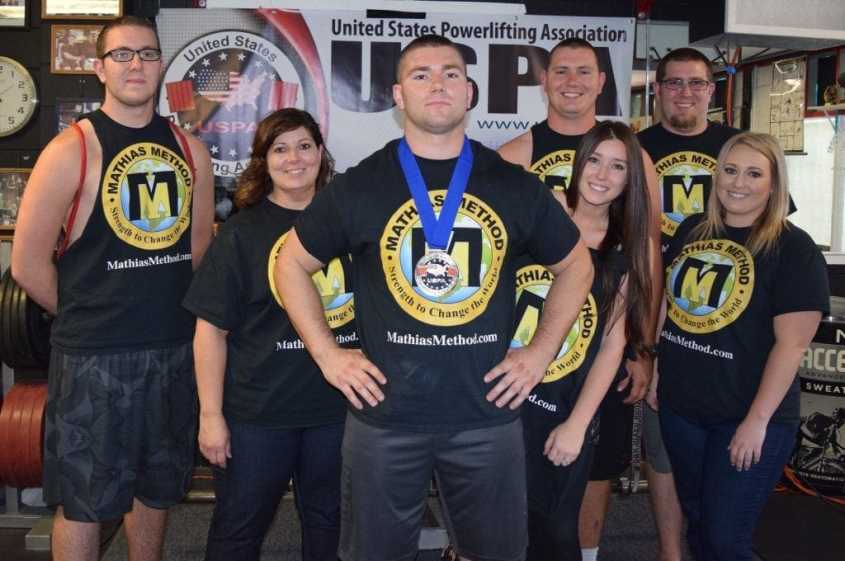
Mathias Method Army supporting their General at a USPA Meet

What is the Mathias Method Strength Team?

STRENGTH WARRIORS are a group of individuals who all have a similar goal in mind of getting stronger. This includes physically stronger through training as well as mentally stronger by encouraging, motivating and helping others around themselves become more focused, self-disciplined and dedicated to bettering themselves every day.

We are a group of individuals who can help each other progress towards any goal, as we are open to all forms of training; including powerlifting, bodybuilding, Olympic Lifting, Crossfit, sports training, strongman, general fitness or any other training style, that has strength at its core. We believe in strength as a way to progress, because strength can help you reach any goal faster.

Each Strength Athlete has unique goals and training styles that add to the team’s value. We may have different reasons for training, but we all share the same purpose of building our STRENGTH together; while we travel along our Strength Journeys! 


Who can join the STRENGTH WARRIORS Strength Team?

  • Men & Women (Ages 18+)
  • All experience levels (beginner-advanced)
  • Elite Lifters and Strength Athletes
  • Competitive Lifters
  • Bodybuilders
  • Sport Athletes
  • General Fitness Lifters

All are welcome!
If you are capable and want to get stronger, you can train with us!

All Gym Rules still apply!


Main Lifts

Compound Exercises How-To Guide

The main lifts are the main compound exercises for any powerlifting or strength training workout program. The Big 3 are the squat, bench press and deadlift. Learn how to perfect your technique and lift more weight than ever by clicking on each exercise below!

Learn how to Master the Big 3 in just 12-Weeks!

Main Lifts Big 3 Compound Exercise for strength the Squat

The Big 3

Main Lift Variations

More Exercises >>


Programming Your Main Lifts

Every training session needs a Main Lift, Compound Exercise, or movement.

This compound exercise is the focal point of the workout and the reason you are training for that day. All of the training before and after these main lifts is set to better improve the main exercise. 

The main exercise should be a standard motion that improves performance in your chosen sport. This can be any movement that makes you stronger.

Just remember, your main power lift should be something that builds the most overall strength. It can be a Big 3 compound exercise like the squat, bench press, deadlift, a close variation or something like sprints for running. It just needs to be helpful for you to build the strength necessary to be better at what you want to be better at.

To support muscle recovery and optimize performance, High Impact Plant Protein Powder is a great addition. Packed with HMB, vitamin D3, and plant-based proteins, it fuels strength, endurance, and lean muscle growth safely.

You should also do the most amount of work with this particular compound exercise. If you want to get good at something, then you need to do it a lot. You should spend the most time on this exercise and try to perfect it while still pushing forward.

Try to increase the overall workload or weight every few weeks so that you never stop progressing. 


Compound Exercises for Strength Training and Athletics

Heavy Training Days

For heavy training days, every other week your compound exercises should rotate between moderate and high intensity.

One week the goal should be to work up too or past 90% of that given exercise’s maximum (relative to the # of reps being performed) to build absolute strength. Example: 3 Rep Max = 300 lbs. Use ~270 for most of your work. IF you are moving properly, then you may carefully work up in weight to a maximum of 310 lbs. on occasion.

The next week should focus on repetitions using less than 85% of the maximum, to build muscle and constantly improve technique. This will rotate each week, and skip over week 4 which should always be of low to moderate intensity relative to the main compound exercise focused upon the other 3 weeks (4-week cycle).

If there are two main lifts for your heavy training day (such as squat and deadlift, or bench press and military press), then the two main lifts should also be rotated.

The higher intensity lift should always go first. For example, if the squat exercise is of high intensity the deadlift exercise should be of lower intensity. The next week the deadlift exercise should be performed first at a high intensity, while the squat exercise should be performed afterward with lower intensity.

The same intensity rotation should occur between the bench press only if there is another main lift you do that day, such as Military Press or an Olympic lift.

Most people do not bench press heavy enough to need 2 weeks of rest afterward before going heavy again, so if you recover enough, then you may bench press relatively heavy 3 weeks in a row while using every 4th week as a recovery week with light-moderate weight.

Light Training Days

The main lifts on light training days are still the focus of the training session. Everything should focus on improving this compound movement, which in turn is focused on improving your main lifts utilized on heavy training days.

During light training days the goal is to accumulate volume and practice technique, creating a better potential for strength gains on heavy training days.

These sessions will focus on building muscular size, speed, and endurance while bringing up weaknesses. This allows for different stimuli created through varying intensities.

As your muscles grow and adapt to lighter loads, they will have an increased potential to grow more absolute strength.

Together, light, moderate and heavy loads utilized on the main lifts will allow for continuous growth without stagnation. Keep growing stronger.

Compound Exercises for Bodybuilding

Bodybuilding Athletes generally focus each muscle group one time per week. However, aesthetics athletes can also benefit greatly from adding strength training into their routine as part of their Mathias Method Programming.

During the last 8-12 weeks before a show, it would be best to stick to the techniques that work best for you, but strength training must be a part of all other training times for optimal improvement. 

Bodybuilding Athletes should make their first main movement a strength movement in which they focus on strength along with aesthetics. This should be done by using a moderate amount of weight and training volume that slowly increases over time, as to not waste too much energy on only gaining strength.

An example would be doing 5 sets of 5 repetitions on a main compound exercise, like the squat or bench press, in which the weight stays the same in a given workout, but increases by 5-10lbs every week. This will give proper stimulus for strength along with improving overall growth.

After this movement, all other training may be focused on muscular development.


Main Lift Variations

Variations to the main lifts allow for a different stimulus to the base lifts and can allow for new growth. Any variation used can create an opportunity to build up different areas of the lift or prime mover muscles from different angles.

Variation can be simple or complex, but to build strength towards the main movements, it is important not to vary too far from the original lift.

Start with simple variations such as the addition of pauses and boxes or changing the positioning of hands or feet before moving into more complex lifts with numerous changes.

Examples of some valuable variations to the main lifts are:

  • Stance or Grip
  • Bar Positioning
  • Pauses
  • Boxes or Boards
  • Specialty Bars
  • Range of Motion
  • Accommodating Resistance (Bands or Chains)
  • Assistive Gear

Variation is best used with advanced lifters who have already mastered the main lifts and progress is slowing.

Beginners should rarely use variations in the main lifts if at all.

Intermediate lifters can try some compound exercise variations infrequently but most work should be done to perfect the main lifts.